Public Frontier · Volume 1 · 2026
Public Frontier: an open laboratory for finding new worlds with AI and public data
*Anyone can join. Membership is one small record in your own ATProto repository.
(Received 8 October 2026)
In September 2026 an independent researcher reported a possible planet about 1.4 times the size of Earth, found in public data from NASA's TESS satellite. He wrote the analysis with an AI coding assistant, published all of his code and data, and said plainly that the signal is a candidate. Public Frontier is a home for work like this. Anyone can download telescope data, search it with open tools and AI help, and share what they find together with the code and data needed to check it. Other people rerun the analysis, look for mistakes and discuss what would settle the question. We start with planets around other stars and will open other areas of astrophysics as the community grows.
I.Introduction
On 25 September 2026, Pavel Rabtsevich, an independent researcher in Tarragona, Spain, posted a preprint about TIC 4206066, a nearby late-K dwarf star.[1][1] Rabtsevich, P. (2026). Two Transit-like Signals in TESS Photometry of the Nearby K Dwarf TIC 4206066. Preprint, Zenodo. doi.org In data from NASA's Transiting Exoplanet Survey Satellite (TESS), he found a dip in the star's brightness that repeats every 3.18 days. It is about 500 parts per million deep and shows up in 23 transits across three observing sectors. If a planet causes it, and if that planet orbits this star, the planet is about 1.4 times the radius of Earth. The note does not claim more than the data support. It names the main alternative, a planet around an unseen companion star, and states that no statistical validation is claimed. Claude Code, an AI coding assistant, helped with the code, calculations, figures and drafting under his direction. The full data and code are public.[2][2] Rabtsevich, P. (2026). Supporting data and code for "Two Transit-like Signals in TESS Photometry of the Nearby K Dwarf TIC 4206066". Zenodo. doi.org
Now the claim faces a clean test. The TESS mission granted two-minute observations of the star for its Sector 110, which runs from 31 October to 26 November 2026.[3][3] TESS Science Office (2026). Director's Discretionary Targets, program 100: two-minute cadence for TIC 4206066. tess.mit.edu Before those data exist, Rabtsevich published the exact transit times he expects and the rule he will use to judge the result.[4][4] Rabtsevich, P. (2026). A Pre-registered TESS Sector 110 Test of Two Transit-like Signals in TIC 4206066. Zenodo. doi.org When those data reach the public archive, anyone can check whether the dips come back on schedule.
Amateurs and volunteers have found real things in public astronomy data for years, as our review of that history shows. What has changed is that a careful person can now write and run a professional-grade analysis with an AI assistant, on data that is free to download. What has not changed is that most signals turn out to be something else, such as eclipsing binary stars, light from a neighbouring star or quirks of the instrument. The work that matters is the checking.
II.How this lab works
Public Frontier is built around one loop. You can join it at any step.
- Learn on a known planet. The tutorial downloads real TESS data and finds a confirmed planet from scratch, step by step, with a notebook you can run.
- Search. Point the same method at stars nobody has looked at closely. An AI assistant can write the code, but you should be able to explain every line.
- Check. Compare odd and even transits, look for a secondary eclipse, look for contaminating neighbours, and search the catalogues to see if the object is already known.
- Share. Publish a short note with your figures, measurements, code and data, and say how you used AI. Mark it honestly as a candidate, a recovery of a known object, or a false positive.
- Discuss. Others rerun your notebook, question the steps and suggest what would confirm or rule out the signal. When something is published or confirmed, the author updates the note.
Notes and comments are stored as public records in each author's own ATProto repository, the open protocol behind Bluesky. This site only reads and displays them. You keep your work if this site disappears, and anyone can build another view of the same records.
III.Recent discoveries
No discoveries have been shared yet. Be the first: recover a known planet, then share the note.
IV.Start here
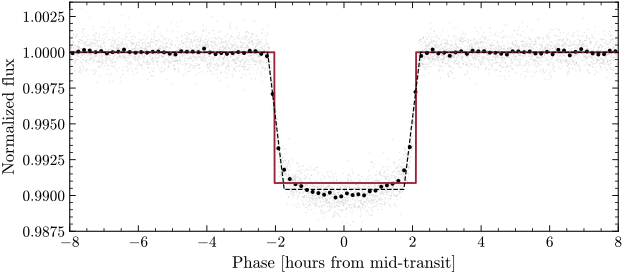
If you have never looked at a light curve, start with Find your first planet. It recovers the giant planet HD 2685 b from two sectors of TESS data. The notebook runs in a few minutes in Google Colab with nothing to install, downloads about 85 MB, and ends with numbers you measured yourself. Every figure and number in the tutorial came from running that code on NASA data.
V.Research programmes
| Programme | Status | Public data | Where results go |
|---|---|---|---|
| ExoplanetsSearch TESS and Kepler light curves for the small, repeating dips a passing planet causes, then help test candidates with follow-up observations. | open now | TESS data at MAST, TESScut full-frame image cutouts | Planet Hunters TESS, ExoFOP community candidates |
| Variable stars and eclipsing binariesFind, measure and classify stars whose brightness changes, including eclipsing binaries, using survey light curves or your own photometry. | coming later | AAVSO International Database, Gaia Archive, including DR3 variability | International Variable Star Index (VSX), AAVSO International Database |
| TransientsCatch new supernovae, kilonovae and tidal disruption events in public alert streams and report them to the Transient Name Server. | coming later | ZTF public data and alerts, Rubin Observatory alerts and brokers | Transient Name Server discovery report, Transient Name Server classification report |
| Galaxies and gravitational lensesClassify galaxy shapes, flag unusual galaxies and look for gravitational lenses in deep public sky surveys. | coming later | DESI Legacy Imaging Surveys, DESI data releases | Galaxy Zoo, Space Warps: ESA Euclid |
| Asteroids and cometsMeasure precise positions of asteroids and comets, search archival images for moving objects, and report to the Minor Planet Center. | coming later | ZTF at IRSA, NEO Confirmation Page | Minor Planet Center, International Astronomical Search Collaboration |
| Brown dwarfs and nearby starsSpot faint brown dwarfs and fast-moving nearby stars by blinking infrared images from NASA's WISE mission. | coming later | CatWISE2020 catalogue, unWISE coadds | Backyard Worlds: Cool Neighbors, Backyard Worlds discovery form, via the project FAQ |
VI.Principles
- Show your work. Link the code and data that produced every figure. A claim nobody else can rerun is not worth much.
- Candidates are candidates. Call a signal a planet only after independent follow-up confirms it. "Candidate" is an honourable word.
- Negative results count. Showing that a signal is an eclipsing binary saves everyone else the time.
- Say how you used AI. Which tools, for what, and how you checked their output. Using AI is welcome here. Hiding it is not.
- Look before you announce. Check ExoFOP, the NASA Exoplanet Archive and SIMBAD first, using this checklist. Recovering a known object is good practice; announcing it as new is embarrassing.
- Your records are yours. Notes and comments live in your own repository. You can edit or delete them at any time.
Acknowledgments
This site includes data collected with the TESS mission, obtained from the MAST data archive at the Space Telescope Science Institute (STScI). Funding for US Institutions for the TESS mission is provided by the NASA Explorer Program. STScI is operated by the Association of Universities for Research in Astronomy, Inc., under NASA contract NAS5-26555.[5][5] Mikulski Archive for Space Telescopes (2026). Mission acknowledgements: TESS. Space Telescope Science Institute. archive.stsci.edu The tutorial relies on Lightkurve and Astropy. Notes are stored as standard.site documents with Leaflet content blocks. The drawings are ink studies made with an image model from public-domain references and historical telescope drawings.
References
- [1]Rabtsevich, P. (2026). Two Transit-like Signals in TESS Photometry of the Nearby K Dwarf TIC 4206066. Preprint, Zenodo. https://doi.org/10.5281/zenodo.22967456
- [2]Rabtsevich, P. (2026). Supporting data and code for "Two Transit-like Signals in TESS Photometry of the Nearby K Dwarf TIC 4206066". Zenodo. https://doi.org/10.5281/zenodo.22967099
- [3]TESS Science Office (2026). Director's Discretionary Targets, program 100: two-minute cadence for TIC 4206066. https://tess.mit.edu/science/ddt/
- [4]Rabtsevich, P. (2026). A Pre-registered TESS Sector 110 Test of Two Transit-like Signals in TIC 4206066. Zenodo. https://doi.org/10.5281/zenodo.23175179
- [5]Mikulski Archive for Space Telescopes (2026). Mission acknowledgements: TESS. Space Telescope Science Institute. https://archive.stsci.edu/publishing/mission-acknowledgements